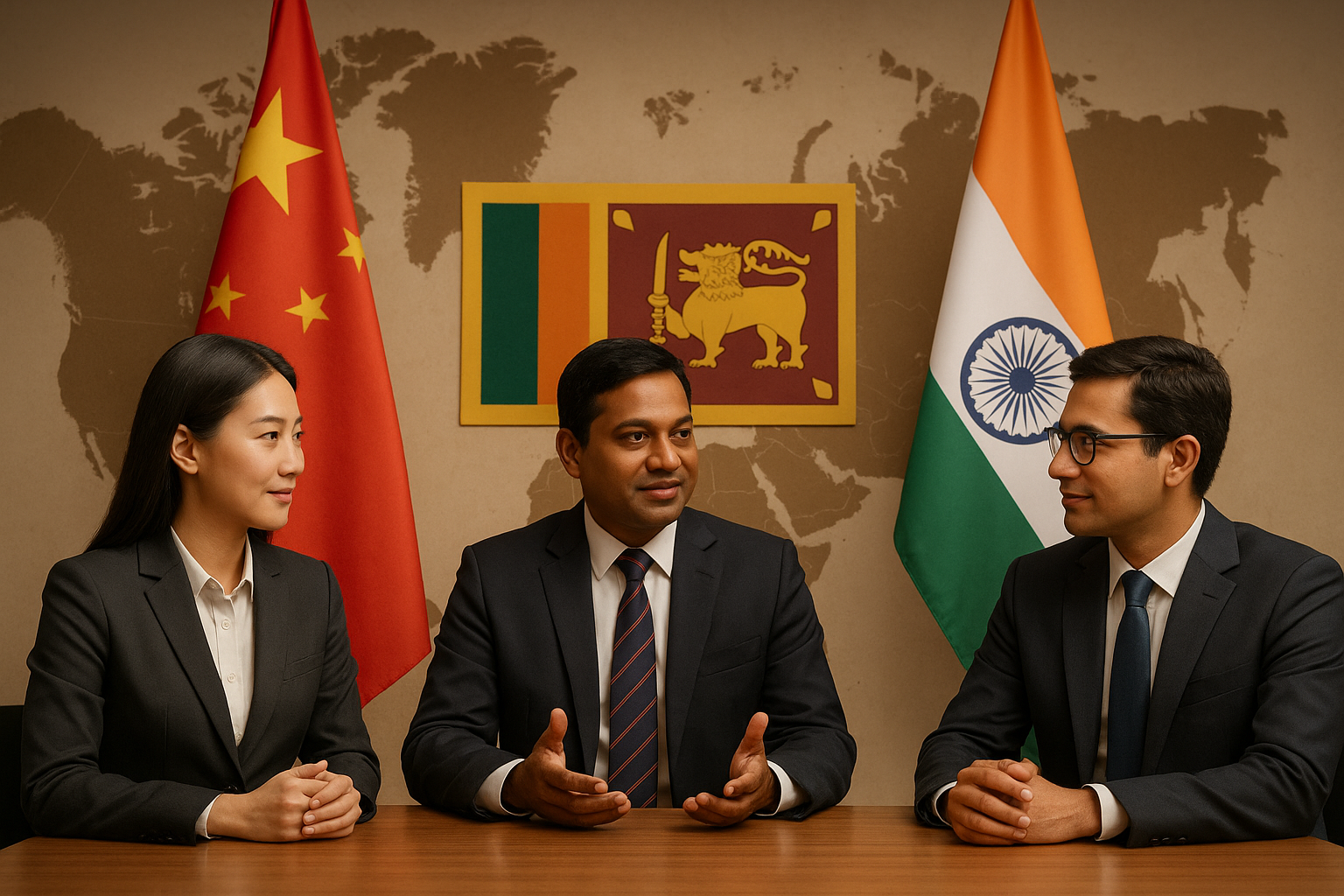
In the 21st century, the field of Sino-Indian business studies and diplomacy has evolved into one of the most dynamic and strategically significant domains of Asian scholarship and practice, with Sri Lanka consistently occupying an important intermediary position.
At the start of the century, China consolidated its role as a global manufacturing powerhouse, while India expanded its influence through services, technology, and pharmaceuticals. This dual rise created both competition and cooperation, shaping a framework where regional neighbors such as Sri Lanka became crucial observers, participants, and facilitators of dialogue. The objectives driving these developments were multifaceted: strengthening trade corridors across the Indian Ocean, institutionalizing academic and business research cooperation, and fostering peace diplomacy that extended beyond commerce into questions of negotiation, mediation, and regional stability.
Tendencies such as the increasing centrality of maritime and logistics diplomacy, particularly around ports like Colombo and Hambantota, the importance of cultural and diasporic business linkages, the gradual shift from bilateral to trilateral engagements involving Sri Lanka as a third-party facilitator, and the rise of structured think-tanks and academic programs defined the landscape. In this context, Sri Lanka became both a physical node in the Belt and Road Initiative, India’s Act East framework, and a symbolic platform for balance, neutrality, and dialogue.
Against this historical background, the contemporary role of ICAS DP reflects a maturation of business diplomacy as both a scholarly pursuit and a practical diplomatic instrument. ICAS DP positions itself as a neutral platform for Sino-Indian engagement, bringing together associated practitioners, academics, and business leaders for structured dialogue, research, and training.
Its work emphasizes contemporary aspects of business studies through education that are highly relevant for the region:
- comparative analyses of innovation economies that contrast India’s strengths in digital entrepreneurship and services with China’s manufacturing-driven systems;
- rethinking business concepts in light of post-pandemic vulnerabilities, with Sri Lanka framed as a logistical, provisional and diplomatic buffer hub;
- promoting sustainability and green diplomacy, where energy, environmental management, and circular economy models become part of business negotiations.
Business diplomacy in this framework goes beyond transactional trade and thus incorporates questions of trust-building, cultural understanding, and the art of negotiation, where Sri Lanka offers both physical space and intellectual mediation.
ICAS DP embodies the tendencies that have shaped Sino-Indian relations over the past two decades: it transforms Sri Lanka’s geographic centrality into diplomatic centrality, integrates business studies with real-world policy outcomes, and develops a model of academic-driven business diplomacy that is uniquely suited for a multipolar Asia.
ICAS DP (Sri Lanka) builds its strength by linking with world-leading universities and research centers that focus on business studies, diplomacy, and Asian affairs. These connections give the institute access to global expertise while allowing it to share Sri Lanka’s unique perspective as a neutral hub between India and China. ICAS DP integrates associated scholarship support with top institutions in India, Europe, North America and Australia through joint research, academic exchanges, and international conferences.
This cooperation helps bring the latest knowledge on trade, supply chains, innovation, and diplomacy into the South Asian context. By combining global academic excellence with local experience, ICAS DP positions itself as a bridge: it connects theory with practice, and international scholarship with the real challenges of Sino-Indian relations, all while highlighting Sri Lanka’s role as a mediator in Asian business diplomacy.
Welcome to follow our events, education programs, membership affiliated news